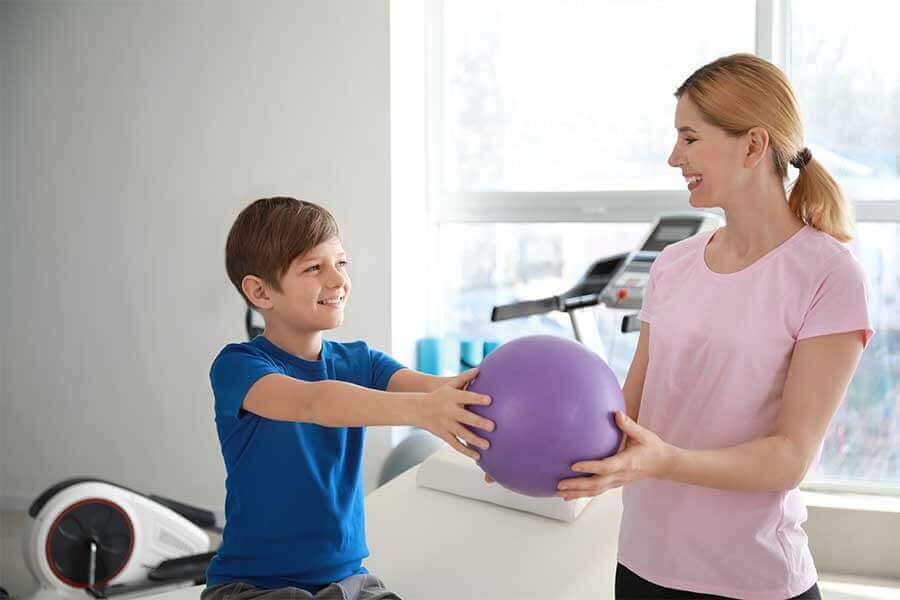

Does your child have autism Therapy can improve their coping skills and quality of life
Working with a pediatric physical therapist will assist your child with autism in developing a variety of skills that are necessary in everyday life. This form of physical therapy, also known as “occupational therapy,” focuses on sensory and neuromotor skills in order to help children become more functional and independent.
Children on the autism spectrum face a range of challenges in school and daily life. If you’d like to know more about how pediatric physical therapy can potentially help your child on the spectrum, stop by or give us a call to schedule an appointment.
Benefits of pediatric therapy for children with autism
As stated by ChoosePT,
“Children with autism spectrum disorder (ASD) have delays in the development of basic skills. These delays occur in specific areas. They may struggle to talk to and connect with others. They also may have limited and repeated behavior patterns. Often, there is a delay in forming motor (movement) skills.
Coordination and posture control are areas where children with ASD may struggle. Copying the actions of others is also hard for them. Symptoms of ASD vary from mild to severe. ASD occurs in about 1 in every 59 births in the United States. It is about 4 times more likely to occur in boys than girls.
Physical therapists (PTs) are movement specialists. They are in a unique position to help children with ASD. PTs help children with ASD develop their gross motor skills and basic movement skills. These skills help children with ASD play games, sports, and take part in physical education with their peers. PT’s help children with ASD gain their full potential.”
For younger children, physical therapy sessions are normally just 20 to 30 minutes long. Sessions can be extended up to an hour as they get older.
Your therapist will collaborate with you to devise techniques to help your child learn vital skills like grooming (brushing teeth, combing hair, etc. ), eating (properly using utensils and napkins), and dressing separately, as well as social skills, fine motor skills, and visual processing skills.
There will also be directed techniques that you can use at home and at your child’s school. When your child gains new abilities and is able to work more independently, strategies can be updated.
Find the best holistic treatment for your child
When it comes to treating a child on the autism spectrum, pediatric physical therapy is always just one piece of the puzzle.
Autistic children’s behavioral needs are diverse, and there is no one-size-fits-all treatment plan.
Depending on your child’s needs, they may also benefit from the following types of treatment in addition to physical therapy:
- Speech-Language Therapy: Depending on your child’s speech skills, a speech therapist might work with them on conversational speech and vocabulary, nonverbal communication, sign language or other forms of communicating.
- Augmentative and Alternative Communication (AAC): This form of treatment involves using pictures to develop simple connections and augment the child’s ability to communicate desires to others. For example, a nonverbal child might learn to point to a glass of water when they are thirsty.
- Sensory Integration Therapy: Many autistic children have difficulty processing sensory information (smells, touch, sight, sound, movement). This type of pediatric therapy involves working with a child on sensory stimulation to help them process incoming information at a neurological level.
- Physical Therapy: Kids on the autism spectrum also have trouble with sitting, running, jumping, walking, and other gross motor tasks. A pediatric physical therapist will work with your child to help them improve muscle tone, balance, and other skills.
What is a typical pediatric physical therapy appointment like
Your child will work with a pediatric physical therapist to help them learn, develop, play, and enjoy life to the fullest. Occupational therapy can help your child improve fine and gross motor skills as well.
The goal at the “macro” level is to assist them in transitioning into adulthood so that they can live independently. Jumping, dancing, and climbing are some of the more popular activities used in therapy. At other times, it will concentrate on particular activities such as buttoning a shirt, eating, writing with a crayon or pencil, or getting ready.
As the parent, you’ll be given helpful guidelines and tasks to work on with your child at home. Your role in your child’s therapy is obviously even more important than that of the physical therapist.
Contact us to get started
Physical therapy for children may assist your child in reaching his or her full potential. At our clinic, physical therapy sessions are healthy, welcoming, and motivating.
Contact our office today to set up an appointment for an assessment or to begin therapy for your child on the autism spectrum.
Sources:
- https://www.choosept.com/symptomsconditionsdetail/physical-therapy-guide-to-autism-spectrum-disorder
Tags: Health, wellness, autism, pt, healthytips, healthandwellness, physicaltherapist, physicaltherapy