
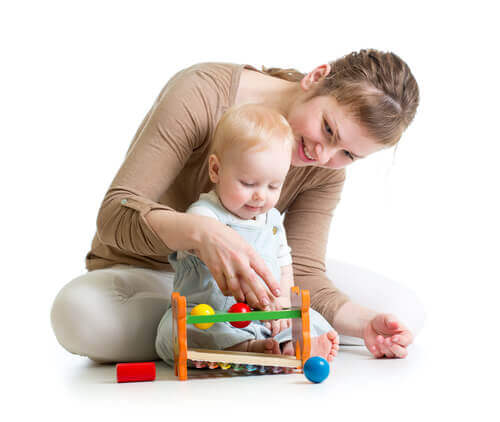
Does your child need help with fine motor skills, gross motor skills, visual perception, eye-hand coordination, problem-solving or maybe planning and sequencing? What are his language abilities? Will the toy require multiple systems to be working together – i.e. balance, eye-hand coordination and timing?
Does your child like a challenge or is he easily frustrated? Be careful not to overreach. Toys and games that are too much of a challenge will be avoided like the plague. But even if you choose a toy or game that is a little out of reach, you can modify it so that your child experiences success.
Below are some toy and game suggestions for various ages. Be sure to ask your child’s occupational, physical or speech and language therapist if you have any questions about what might be appropriate for your child’s skill level.
1 to 3 MONTHS
Mobiles, unbreakable mirrors and activity centers for the crib, rattles, stuffed toys with black and white patterns, music boxes, large colorful rings
4 to 6 MONTHS
Squeaky toys, mouth toys, books made of cloth/vinyl, playing peekaboo and tickle, singing
7 to 9 MONTHS
Stuffed animals, balls, nesting cups, pop-up toys, large dolls and puppets, bath toys, pat-a-cake and other nursery rhyme play
10 to 12 MONTHS
Push and pull toys, ordinary household objects like containers and large spoons, stackable rings, playing simple ball games
13 to 15 MONTHS
Toy telephone, acrobatics, pushing a toy carriage/shopping cart, large building blocks, simple ride-on toys, movement games to song
16 to 18 MONTHS
Sandbox, simple musical instruments, large colored beads, jack-in-the-box, blowing bubbles, simple puzzles
19 to 21 MONTHS
Toys to take apart and put back together, digging toys, large crayons, kiddie cars, water games, easy jigsaw puzzles, making mud pies, playing tag or hide-and-seek
22 to 24 MONTHS
Kiddie lawn mowers, kitchen sets and other make-believe play sets, modeling clay, construction sets, action toys like trains, telephones, dump trucks and fire engines, tubes and containers with lids
2 to 3 YEARS
Beginner tricycle, mini trampoline, preschool roller skates, dolls and doll accessories, dress-up clothes, coloring books, easel, crayons and markers, music, swing sets, books, finger paint, mini basketball hoop, woodworking bench
Playing is an essential part of a child’s development. If you notice your child is not progressing with their speech, physical abilities or social skills, we can help guide you in the right direction. Contact us today to find out how we can help your child live life to the fullest.
Tags: Child, Physical Therapy Exercises, ADHD, Exercise, Muscular Dystrophy, Speech Therapy, Establish a Routine, Occupational Therapy, Child Development